
I’m passionate about technology. I’m very interested in it and always have been. Like most people, my job requires the use of computers, in fact, when concerning our reliance on them, maybe even more so. In a live sport television broadcast, in Formula 1 especially, at each event we provide the technical infrastructure needed to deliver timing services, on board cameras, data acquisition, and in my particular department; production of the international TV feed, as well as post-production of content across each Grand Prix weekend. So, we rely on computers implicitly.
During a conversation with a fellow Producer over lunch, who happens to be a qualified Astrophysicist, we were discussing the fact that Mars is the only known planet solely populated by robots. I’m also currently reading Stephen Fry’s excellent book ‘Mythos‘, a vivid retelling of the ancient Greek myths for our modern age, and in that two of the most primal and most loved Greek myths are to do with the creation, namely of mankind. Connections between Fry’s extraordinary storytelling, and our conversation about Martian robots in the Formula 1 canteen over baked cod with tomato salsa can be made, especially regarding recent Artificial Intelligence (AI) developments.
When looking at the creation of the Gods, at a point in which the poet Hesiod calls the ‘theogony‘, the ‘birth of the Gods‘. Our champion, a titan called Prometheus made human beings in clay, mixed the spit of Zeus and the breath of Athena, and gave them life. But Zeus refused to allow us to have fire, and the fire I think means both literal fire, to allow us to become Bronze Age man, to create weapons and to cook meat and to frighten the fierce animals, to become the strongest physically and technically, but also the internal fire of self-consciousness and creativity, the divine fire. Zeus didn’t want us to have it.
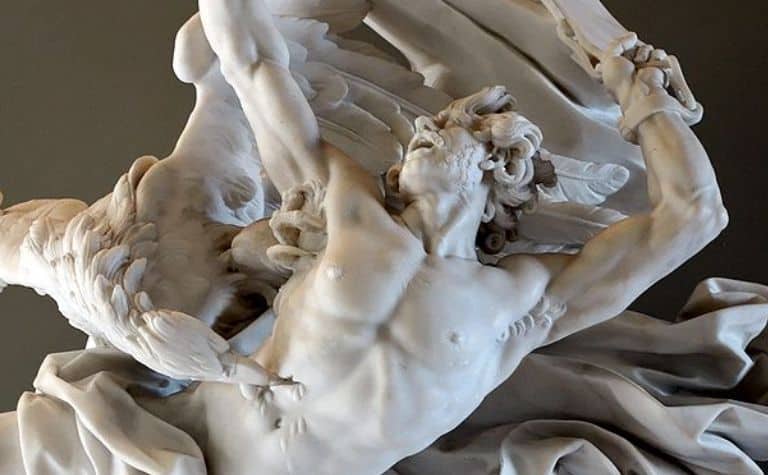
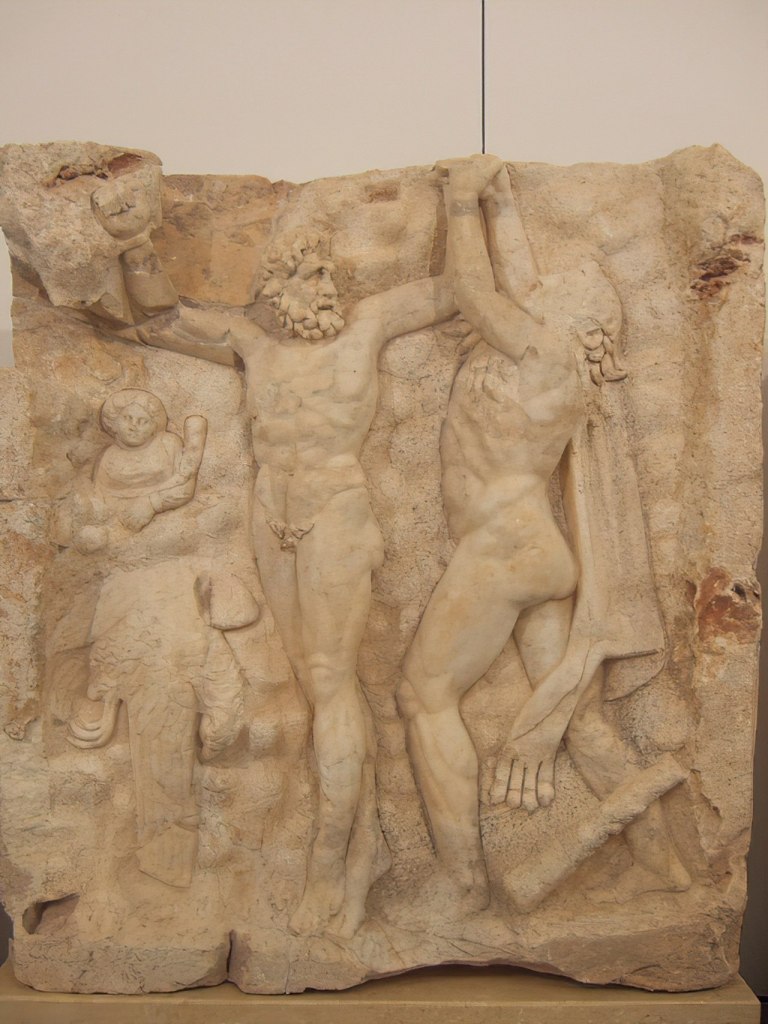
Prometheus stole fire from the heavens and gave it to man, and Zeus was so angry that he punished Prometheus by chaining him to a mountainside. He was immortal Prometheus, and every day his liver was torn out by an eagle (in ancient Greece, the liver was thought to be the seat of human emotions), and it grew back, and every day it was torn out again, for perpetuity, until he was eventually rescued by Heracles.
The other punishment; was that Zeus and the other gods created Pandora, the all gifted, that is what ‘Pan’ ‘all‘ doran ‘gifted‘ means, and sent her down to Earth as the first woman. She had everything. But he also gave her this jar, which we sometimes call a box, which actually was the mistaken translation from a very famous Netherlandish intellectual called Erasmus, who mistook the Latin pithos and pyxis, when he retold the myth in Latin in 1508, he translated it as box, but it should actually be a jar.
But Pandora was told that under no circumstance should she look in the jar, she was beautiful she had everything, all the gifts from the gods were given to her, but she had this curiousity, our curiousity, and she opens the jar and I’m sure you know the story, out flew hardship, lies, deceit, murder, pestilence, all the ills of the world. The golden age was over. She slammed the lid back on, and one little fairy was left inside. Elpis. Hope.

Now, that’s fine, that seems like an interesting story, it’s an interpretation. But actually, if you think about it in the present, firstly the Prometheus story, as soon as mankind shook off the chains of religion, and the church, we became incredibly interested in the Prometheus story, because it suddenly said we don’t have to bow down and apologise to a god. Gods must apologise to us for denying us our independence and our sense of ourselves and our fire. And so Percy Bysshe Shelly wrote ‘Prometheus unbound‘ (1820), the poem, Beethoven wrote ‘Prometheus Overture‘ (1801), all within twenty years of each other, the height of ‘the enlightenment’ if you like, and the beginning of the romantic era.
Now we’re going to put that to one side, and I’m going to go back to 1989, when I became fascinated in this extraordinary new development in which you could network computers to a network of networks, which was starting to be called the ‘Internet‘. There was no web, there was no graphical application, it was all text based but I was really excited about it. And as it grew and grew, I became more and more excited about it. I thought this is the biggest and most exciting bringing together of human beings in the history of our planet. It is the all gifted. It will give us freedom to access knowledge, we will share things; art, politics, boundaries will be dissolved. We will learn to love each other; we will all be brothers and sisters. Like in Beethoven’s 9th; we all ‘will become brothers‘. It will be fantastic. And in time social media came, and the Arab Spring, and I thought there will be no more tribalism, no more hatred, no more racism, this would be wonderful. But what happened?
The lid opened, and out came trolls, out came abusers, out came racists, and tribalists and insulters. The worst kind of humanity. It was an exact replay of Pandora’s box. And I thought that that was so interesting, that the Greeks had this understanding, that when we have something that seems so perfect, there is no possibility but that it also contains its opposite.
Now, I guarantee you, whether you like to think it or not, that although we know through Darwin, and science and genes, that we were not created by an intelligent designer, in 100 year’s time, we can guarantee there will be sapient creatures, sapient beings on this Earth, that have been intelligently designed. You can call them robots, androids, cyborgs, you can call them compounds of augmented biology, artificial intelligence, but they will exist. The first person to live to 200 years old has already been born. The future is enormous, it’s never been more existentially transformative. My question is this;
When the Prometheus comes, and makes the first really impressive piece of robotic AI, like Frankenstein, like the Prometheus back in the Greek myth, they will have a question. Do we give it fire? Do we give these creatures self-knowledge? Self-consciousness? An autonomy that is greater than any other machine has ever had and will it be similar to ours?
In other words, shall we be Zeus and deny them fire because we are afraid of them? Because they will destroy us? The Greeks and the human beings did destroy the Gods, they no longer needed them. And it is very possible we will create a race of sapient beings that will not need us. Will they be as imperfect as we are? Almost certainly yes. I hope so. But we will be redundant. In some places in our Solar System, we can argue that we already are. As I’ve mentioned Mars is a planet solely populated by machines, by robots, although not sapient, mechanical creatures roaming the landscape nonetheless, conducting tasks, on a place that we currently are incapable of setting foot on.

This is not trivial. The question it seems is about who we really want to become as a species?
Currently the world is filled with talk, rumour and excitement, with a fair dose of confusion and fear, about the growing use of artificial intelligence. One of the most popular AI tools available to the public today is ChatGPT, an AI-powered language model that has been “trained” and fed vast amounts of online information. After taking all that in, ChatGPT can regurgitate human-like text responses to a given prompt. It can respond to queries, discuss a lot of topics and publish pieces of writing.
It isn’t difficult to imagine a robot on the surface of Mars, factory-wired with ChatGPT or a similar AI language model. This ‘smartbot’ could be loaded with a suite of scientific devices. It could analyse what its instruments are finding “on-the-spot,” perhaps even collating any evidence of past life it uncovers nearly instantly.
That data could be digested, assessed, appraised and assembled in some AI form. The product, in well-paginated condition, could then be transmitted directly from the robot to the scientific community. Of course, that paper would then be peer reviewed.
“How funny that we still argue about the definition of life as we know it, and we’re starting to use a tool in that search that also stretches the definition of life,” said Amy Williams, assistant professor in Geological Sciences at the University of Florida in Gainesville. She is a participating scientist on the NASA Curiosity and Perseverance rover missions that have robots scouting about on Mars.
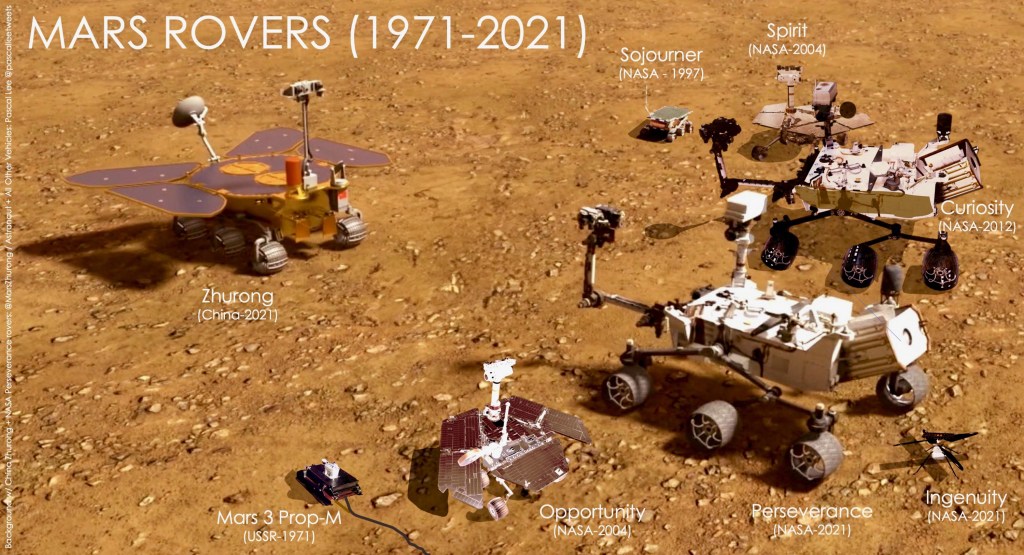
As of May 2021, there have been six successful robotically operated Mars rovers; the first five, managed by the American NASA Jet Propulsion Laboratory, were (by date of Mars landing): Sojourner (1997), Spirit (2004–2010), Opportunity (2004–2018), Curiosity (2012–present), and Perseverance (2021–present, which carried the hugely successful Mars Helicopter Ingenuity attached to its belly). The sixth, managed by the China National Space Administration, is Zhurong (2021–present).
In August 2013, NASA decided to use Curiosity’s sample-analysis unit’s vibrations for something a little different. To celebrate the mission’s first successful year on Mars, engineers programmed the unit to vibrate to a musical tune. From inside a Martian crater, millions of miles away from home, Curiosity sang “Happy Birthday” to itself.
The news of Curiosity’s mini celebration of perhaps the loneliest birthday in the galaxy prompted a deluge of empathy in comment sections around the Internet. “WHEN HUMANS LAND ON MARS, WE BETTER DAMN GIVE THAT ROVER A HUG!!!” one user wrote. The thought of a space robot serenading itself all alone certainly tugs at the heartstrings.
NASA counts the anniversaries in Earth years, which are shorter than Martian years. But the rover didn’t sing. “The reports of my singing are greatly exaggerated,” the rover’s Twitter account reported, presumably referring to news coverage about its fifth birthday. “I only hummed ‘Happy Birthday’ to myself once, back in 2013.”
It was the use of the robot talking in the first person that was also new; ‘I’ only hummed…’ This use of robotic/sapient ‘personality’ can also be seen with the European Space Agency’s Rosetta spacecraft that studied Comet 67P/Churyumov-Gerasimenko & sent the Philae lander to its surface. The mission completed on the 30th of Sep 2016. But it was the sentiment of the spacecraft/lander’s achievements told in the “Once upon a time” cartoon series that long outlasted the mission’s completion.

Although not entirely without precedent, the approach that the European Space Agency chose, and its subsequent implementation surpassed expectation and proved to be highly successful. It gave the Rosetta mission something no amount of cleanroom engineering can bestow – heart.
As the mission itself drew to its eventual, and inevitable close, the world had fallen head-over-heels in love for the two astronauts. We no longer thought of them in terms nuts-and-bolts – Rosetta and Philae had become our ambassadors, seeing, touching and tasting what we couldn’t, and doing it all with a sense of awe and wonder on their ‘imaginary’ faces, smiling as they go.
When the mission finally concluded and Rosetta and Philae signed-off with Mission Control, an overwhelming sense grief was felt by the teams of engineers and scientists involved, and equally by those uninvolved in the mission.
In a similar instance, NASA’s Mars Perseverance rover is carrying an adorable ‘family portrait’ of Martian rovers. Raw images from Perseverance, which safely landed on the surface of Mars (on the 18th February 2021), revealed a small plaque featuring a line-up of little spacecraft. The symbols represented all of NASA’s Mars rover missions that had previously made it to the surface of the Red Planet. Perseverance’s ancestors.

The rovers themselves are lined up in the same chronological order that they landed on the Red Planet: The Sojourner rover (1997), the twin Mars Exploration Rovers Spirit and Opportunity to (2004), the Curiosity rover (2012) and Perseverance itself. But remember this is a ‘family’ portrait.
Family represents the foundation of one’s self, and a unity of acceptance, unconditional sacrifices, joy, support and love that is built on a continuum of resilience, and journey in humility from the past, current and future generations. It is a sense of community. All, very human. All, very now sapient characteristics. This is today. In fact, it has already happened and has already advanced past all of this.
Humanity is undergoing a massive technological shift that many are calling the “fourth Industrial Revolution.” Our World belongs to computers, we just live on it. AI is likely to benefit humankind much like previous economic and technological revolutions have. The internet and computers changed the way we live our lives. There will be a similar shift in how we as humans will occupy our place in the future, our reason, and where that may happen to be. If we do decide to leave our home world and occupy another, Mars is the obvious first choice. However, when we get there, will we be welcomed by those sapient compounds of augmented biology who will, more than likely, already occupy it?
Title image credit: Richie Mason – Freelance 3D Artist
 THE ROGUE ASTRONAUT